What Basement Carpet Cleaning Really Costs: A Real Glenview Job, Priced Line by Line
"What would it cost to do the whole basement?" is one of the most common questions we get, and the honest answer is usually "it depends," which helps nobody. So instead of another price range, here is one real job from start to finish: a finished basement in Glenview, about 2,000 square feet of carpet, two flights of stairs, what we charged for each part, and how long it took.
We are sharing this for two reasons. Homeowners deserve an actual number to anchor on before they pick up the phone, and a real invoice explains pricing better than any list of "factors." After the case study, we use the same numbers to give you ballpark figures for basements of other sizes, explain what would have pushed this price up, and cover the part of basement cleaning most people forget to plan for: drying. If you only want the headline, it is right below. If you want to know how professional carpet cleaning gets priced from our side of the quote, keep reading.
The Short Answer: $520 for 2,000 Sq Ft and 24 Stairs
This Glenview basement cost $520 in total: $420 for roughly 2,000 square feet of wall-to-wall carpet and $100 for 24 carpeted steps across two flights. The job took our crew about three hours on site.
| Line item | Size | Price | Works out to |
|---|---|---|---|
| Basement carpet | ~2,000 sq ft | $420 | ~$0.21 per sq ft |
| Carpeted stairs (2 flights) | 24 steps | $100 | ~$4.17 per step |
| Total | About 3 hours on site | $520 | No add-ons billed |
Two things stand out in those numbers. First, a large, open basement is one of the most cost-efficient carpet jobs there is per square foot. Second, the stairs cost almost a quarter of the bill while covering only a small fraction of the carpet. Both have straightforward explanations, which we get to below.
The Job: A Busy Finished Basement in Glenview
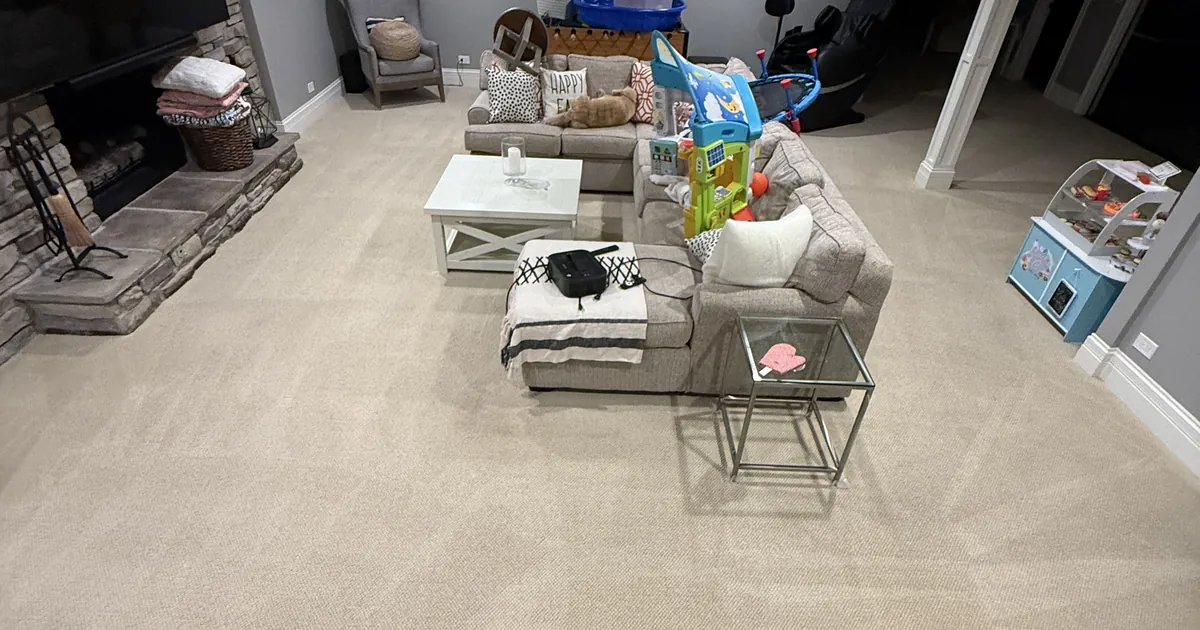
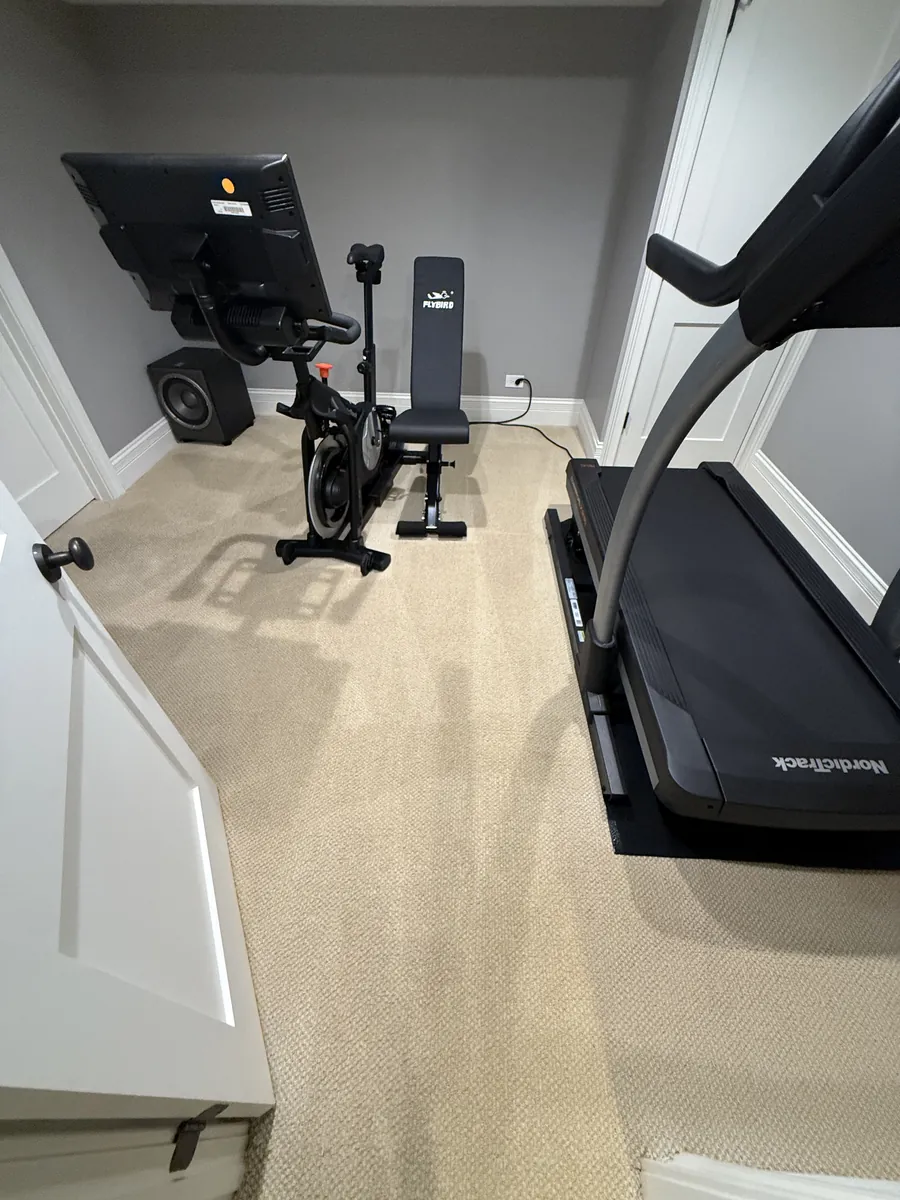
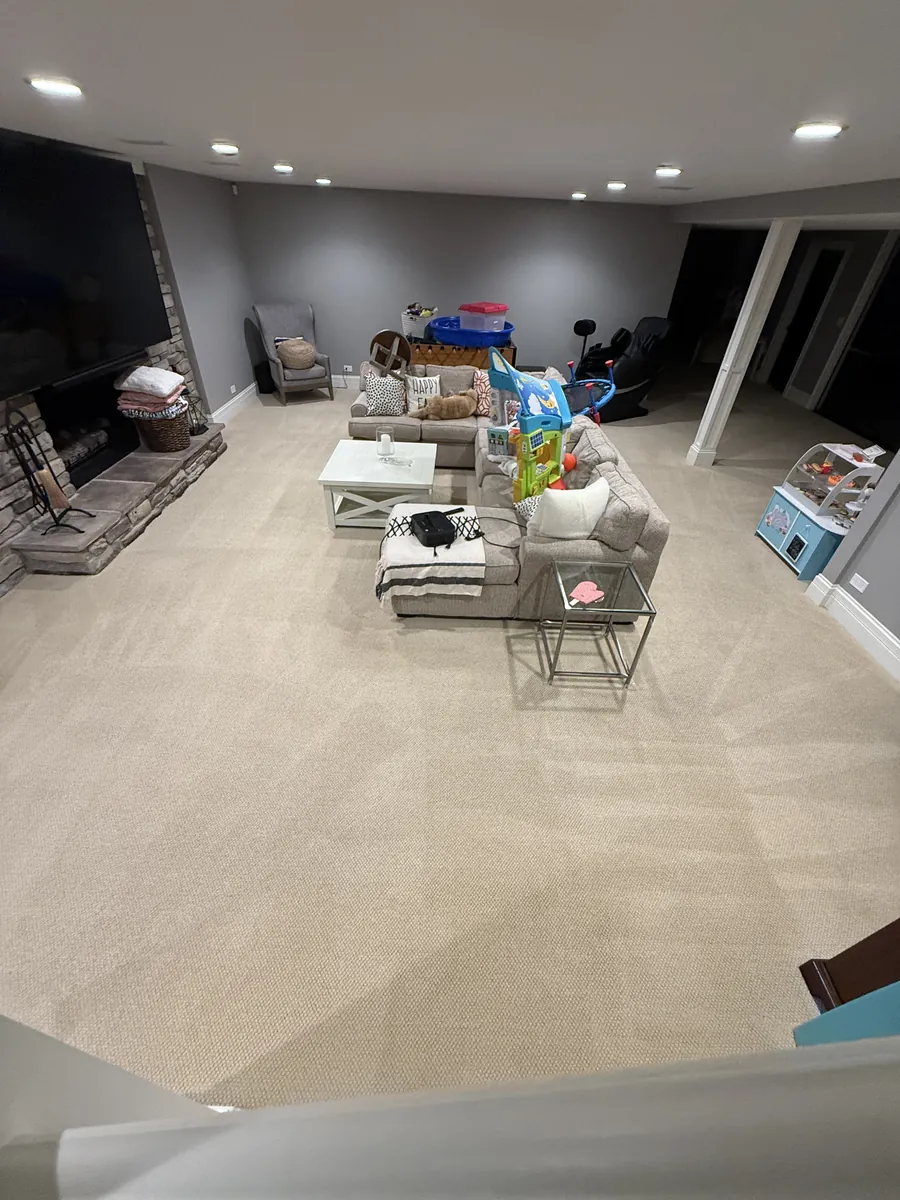
This was a lived-in family basement, not a showroom. It has a large family room built around a stone fireplace and a sectional, a kids' play area with toys lined up along the walls, a separate home-gym room with a treadmill, a bike, and a weight bench, and the hallways that connect them. Getting down there means two flights of carpeted stairs, 24 steps in all. There is a cat in the house too. Finished basements like this are common in Glenview and across the North Shore, and it is a big share of the carpet cleaning in Glenview we do.
The carpet is a light beige, level-loop construction, the nubby, Berber-style texture where the yarn is looped rather than cut. The Carpet and Rug Institute says same-height loops hold "up well in high-traffic areas," and that is exactly why builders like it for basements. It has two quirks that shape how you clean it, though. Soil works its way down to the base of the loops, where a household vacuum struggles to reach. And a light color shows every traffic lane, especially the paths between the stairs, the sofa, and the gym.
This was routine maintenance rather than a rescue: general traffic soil, dull lanes, and the everyday wear of kids, a pet, and workouts. There was no flood, no set-in pet urine, and no stain work that needed its own line item. That matters for the price, as you will see.
How We Cleaned It, and Why It Took About Three Hours
Our process follows the same order on every job, and the order matters more than most people expect. It is built around the ANSI/IICRC S100 standard, the industry's written procedure for professionally cleaning carpet and rugs, and every one of our technicians is IICRC-certified.
1. Walkthrough and dry soil removal
We walk the space first, note the traffic lanes and anything that needs special attention, and then pre-vacuum. Most of the soil in carpet is dry particulate, and on loop pile it sits at the base of the loops. Wetting it before removing it turns loose grit into mud that bonds to the fiber, so taking the dry soil out first makes everything after it work better.
2. Pre-treatment and CRB agitation
Next comes a pre-treatment to loosen oily traffic soil, worked in with our CRB (counter-rotating brush) machine. A CRB has two cylindrical brushes that spin in opposite directions, scrubbing the fiber from both sides and lifting the pile instead of just pushing across it. That is especially useful on a loop carpet, where the soil sits low in the loops, and on the traffic lanes of a light-colored floor, where agitation makes the difference between "cleaner" and "even."
3. Hot water extraction
After agitation, we rinse and extract with truck-mounted hot water extraction. This is the step that actually removes the soil the CRB loosened, instead of leaving it suspended in the carpet. In a basement, it also means running hose from the truck, through the house, and down the stairs, which adds setup time that a first-floor room does not need.
4. Stairs by hand, then grooming
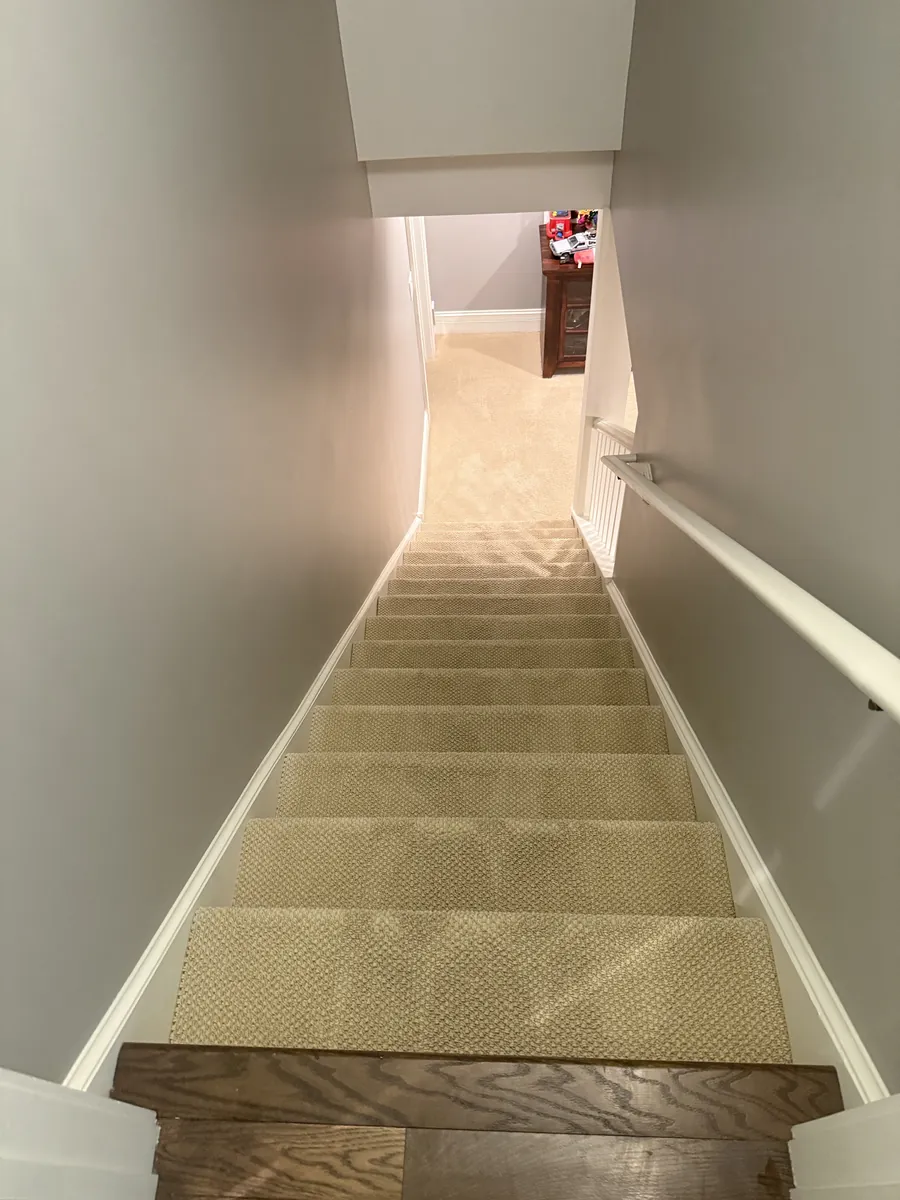
The 24 steps were cleaned one at a time with hand tools: tread, riser, and the nose of each step, where shoes scuff the most. Finally, the open floor is groomed so the pile dries standing up rather than matted flat.
That adds up to about three hours for the whole job. The open floor goes quickly because the machine can run long, uninterrupted passes. The stairs are the opposite: small, fiddly surfaces where the pace is set by your hands, not the equipment.
Why Stairs Are Priced Per Step
If you measure the carpet on a typical step (a tread about 10 inches deep, a riser about 7 inches tall, and roughly 3 feet wide), you get around 4 to 5 square feet per step. Twenty-four steps is only about 100 square feet of carpet, a twentieth of the basement floor.
At this job's floor rate, 100 square feet would have cost about $21. The stairs were billed at $100. That is not padding. It reflects where the time goes. A large floor machine cannot clean a stair, so each step is worked by hand, and the step noses carry the heaviest wear in the house because every footstep lands on them. That is why most companies, including us, price stairs per step instead of by the square foot. When you compare quotes, check whether stairs are included, priced per step, or quietly left off.
How We Priced This Job: Our Side of the Quote
Here is what actually went into the $420 floor price, in the order we think about it.
- Area. About 2,000 square feet is the biggest single driver, and it is the easiest one to estimate.
- Layout. One large, open family room with a few connected spaces is efficient to clean. The same square footage split into six small bedrooms and closets takes longer, because every doorway and corner slows the machine down.
- Soil level. Routine traffic soil, not years of neglect. Heavily soiled carpet needs more dwell time and extra passes.
- Access. Basement work means longer hose runs and more setup, which we factor in up front instead of surprising you with it later.
- Add-ons. None on this job, which kept the invoice to two simple lines.
This is also why a big open basement comes out so much cheaper per square foot than a single bedroom. Much of the cost of any visit is fixed (driving over, setting up, running hose, cleaning up), so a bigger area spreads that cost thinner. It is the same reason we have a $180 minimum on any job. If you are pricing a few rooms upstairs rather than a whole basement, our guide to carpet cleaning prices per visit covers how room-based pricing works and why quotes vary so much between companies.
What a Similar Basement Might Cost You
Using the rates from this job, here is roughly where other basement sizes would land. Treat these as ballparks, not quotes: they assume a similar layout, routine soil, and no add-ons, and we always confirm the price after seeing the space.
| Basement | Stairs | Ballpark |
|---|---|---|
| ~700 sq ft, one open room | None | $180 (job minimum) |
| ~1,200 sq ft | 1 flight, 12 steps | ~$250 + ~$50 = ~$300 |
| ~2,000 sq ft (this job) | 2 flights, 24 steps | $520 actual |
| ~2,500 sq ft | 2 flights, 26 steps | ~$525 + ~$110 = ~$635 |
What Would Have Raised the Price
This job stayed at $520 because nothing unusual was in play. These are the things that would have changed that:
- Pet urine. A cat or dog accident that has soaked into the backing and pad cannot be fixed by a surface clean. It needs enzyme treatment and targeted extraction, which is a separate service. If you notice a smell that comes back on humid days, ask about pet odor removal when you book, so it is quoted up front.
- Set-in stains. Coffee, wine, rust, or dye stains that have had months to set need individual spot work.
- Heavy soil or long gaps between cleanings. Carpet that has gone several years without a professional clean takes more passes and more time.
- Moving heavy furniture and equipment. Sectionals, pool tables, and gym machines take time and care to move safely.
- Water or moisture problems. A basement with a past leak or high humidity may need attention beyond routine cleaning.
Basement Carpet Dries Slower. Plan for It
On a typical job, carpet is dry within 4 to 6 hours. Basements often take longer. The air below grade is cooler and more humid, there are fewer windows, and the carpet sits over a concrete slab that stays cool. None of that is a problem if you plan for it, but it is worth taking seriously. The EPA's guide to mold and moisture notes that if damp materials are dried within 24 to 48 hours, mold will not grow in most cases. Proper extraction leaves carpet damp, not wet, and your goal is to finish drying well inside that window.
- Run a dehumidifier if you have one, starting as soon as we leave.
- Keep air moving. Set your HVAC fan to "on" rather than "auto" and run any ceiling or box fans you have.
- Keep traffic light for the first few hours, and walk on it in clean socks rather than shoes.
- Do not slide furniture back onto damp carpet. Leave the protective tabs or blocks under the legs until it is fully dry.
A little preparation before the appointment also saves time on the day, which keeps your price where it should be. Our guide on how to prepare for carpet cleaning walks through what to pick up, what to move, and what to leave to us.
How to Compare Basement Carpet Cleaning Quotes
A quote is only useful if you know what is in it. Before you book anyone, including us, ask these five questions:
- Is the price for the whole area, or per room? "Per room" quotes can grow fast in a basement with an open plan and no clear room boundaries.
- Are stairs included, and how are they priced? Per step is standard. "Free stairs" usually means the cost is somewhere else.
- Is pre-vacuuming and agitation part of the job? Skipping them is the most common way low-price operators cut time.
- What method and equipment do they use? Hot water extraction is what major manufacturers such as Shaw and Mohawk ask for in their warranties, and you can check whether equipment carries the Carpet and Rug Institute's Seal of Approval, the industry's test for whether cleaning equipment removes soil without damaging carpet.
- Are the technicians certified and insured? Ask for IICRC certification and proof of insurance before anyone works in your home.
We are a family-owned company founded in Chicago in 2004, and we would rather give you a number you can hold us to than a teaser price that changes on the day. If your basement looks anything like this one, or nothing like it, send us the rough square footage and stair count, or book a free estimate, and we will confirm the price before any equipment comes off the truck. You can also call (312) 498-0498.
Frequently Asked Questions
How much does it cost to professionally clean basement carpet?
For the Glenview basement in this article, about 2,000 square feet of carpet, we charged $420, which works out to roughly 21 cents per square foot. Large open basements are among the most cost-efficient carpet jobs per square foot because setup and travel costs are spread over more area. Smaller basements usually land at or near our $180 job minimum, and stairs, pet treatment, or heavy soil are priced on top.
How much does it cost to clean carpeted stairs?
On this job, 24 carpeted steps across two flights cost $100, or about $4.17 per step. Stairs are priced per step rather than by square foot because each tread, riser, and step nose has to be cleaned by hand, so they take far longer than the same amount of open floor.
How long does it take to clean a basement carpet?
This basement, about 2,000 square feet plus 24 stairs, took our crew about three hours on site. That included the walkthrough, pre-vacuuming, pre-treatment with a counter-rotating brush machine, hot water extraction, hand-cleaning the stairs, and grooming the pile.
How long does basement carpet take to dry after cleaning?
Carpet is typically dry within 4 to 6 hours after our cleaning, but basements often take longer because the air is cooler and more humid and the carpet sits over a concrete slab. Run a dehumidifier, set the HVAC fan to on, and use any fans you have. The EPA advises drying damp materials within 24 to 48 hours to prevent mold, and good extraction plus airflow keeps you well inside that window.
Can Berber or loop carpet be cleaned with hot water extraction?
Yes. Level-loop and Berber-style carpet cleans well with hot water extraction when it is done in the right order: a thorough dry pre-vacuum to pull grit from the base of the loops, pre-treatment worked in with a counter-rotating brush machine, then extraction and grooming. Light-colored loop carpet in particular shows traffic lanes, so agitation before extraction makes a visible difference.
How often should basement carpet be professionally cleaned?
Major carpet manufacturers such as Shaw and Mohawk recommend professional hot water extraction every 12 to 18 months. A busy family basement with kids, pets, or a home gym is better kept toward the 12-month end, while a lightly used basement can stretch to 18 months.
Basement carpet takes a lot of wear and gets little attention, because nobody sees it but the family. A real price helps you plan for it. For this Glenview home, that was $520 and about three hours of work for a 2,000-square-foot basement and both flights of stairs. If yours is due, we are happy to give you a number of your own.